
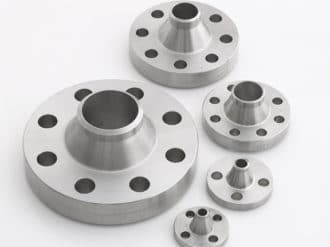
Pipe Flanges & Fittings
Flanges
Stainless steel, chrome moly, special alloy, and carbon steel flanges. NPS 1/2 through 36, ASME classes 150 through 2500.
Sizes: 1/2"–36" NPS
Classes: 150 · 300 · 600 · 900 · 1500 · 2500
Standards: ASME B16.5 · B16.47
Overview
What Are Flanges?
A flange is a forged or cast ring used to connect sections of pipe, or to connect pipe to valves, pumps, vessels, instruments, and other equipment. Flanges are joined by bolting two faces together against a gasket, creating a sealed mechanical connection that can be opened for maintenance without cutting or rewelding.
Flanges allow piping systems to be assembled and disassembled at defined points throughout a run. The right combination of type, face, material, and pressure class depends on operating conditions, fluid service, and how often the joint needs to be opened. Matching all four correctly keeps the joint leak-free under load and serviceable over the life of the system.
Unified Alloys stocks forged flanges per ASTM A182 / ASME SA182 in stainless, chrome moly, and special alloy grades, ASTM A105 in carbon steel, and cast Class 150 flanges in T2-coated carbon steel. All standard ASME B16.5 face types and configurations are available across pressure classes 150 through 2500 and sizes through NPS 36.
Flanges in sizes above NPS 24 fall under ASME B16.47 rather than B16.5. Larger sizes follow B16.47 dimensional standards and are available on request.
Key Applications
- Pipe-to-pipe connections in pressure piping systems
- Equipment connections to valves, pumps, vessels, and instruments
- Access points for inspection, cleaning, and maintenance
- Sealing piping ends with blind flanges
- Oil and gas, chemical processing, power generation, and water treatment systems
Materials & Grades
Available Materials
Unified Alloys supplies flanges across four material families: stainless steel, chrome moly, special alloys, and carbon steel. Forged flanges conform to ASTM A182 / ASME SA182 for alloy grades and ASTM A105 for carbon steel, with dimensions per ASME B16.5 (sizes through NPS 24) and ASME B16.47 (above NPS 24).
The primary choice for corrosion resistance in chemical processing, oil and gas, pulp and paper, and food-grade systems. Standard grades cover both general service and aggressive environments including chlorides and elevated temperatures.
304 · 304L · 316 · 316L · 317L · 321 · 347
Specified where service temperatures and pressures exceed the working range of standard stainless. Common in power generation, refining, and high-temperature process applications.
P5 · P9 · P11 · P22 · P91
For severe service where corrosion, high chloride exposure, or extreme temperatures rule out standard stainless. Used in demanding chemical, marine, and offshore applications.
2205 · 254SMo · Monel · Inconel
Technical Data
Dimensional Data
Our reference charts provide complete ASME B16.5 dimensional data, outside diameters, and tolerances for stainless steel flanges by pressure class. Review individual pages below for specific facing dimensions, weld neck bores, spectacle blinds, and jack screw sizes. All data is for reference only.
Standard Flange Facings : ASME B16.5
Full dimensional data by pressure class
Dimensions of Weld Neck Flange Bores : ASME B16.5
Full dimensional data by pressure class
Dimensional Tolerances (Threaded, Slip-On, Lap Joint and Blind) : ASME B16.5
Full dimensional data by pressure class
Spectacle Blind Dimensions
Full dimensional data by pressure class
Jack Screw Sizes for Ring Joint Face Orifice Flanges
Full dimensional data by pressure class
Class 150 Flanges : ASTM A182 / ASME SA182 – B16.5
Full dimensional data by pressure class
Class 1500 Flanges : ASTM A182 / ASME SA182 – B16.5
Full dimensional data by pressure class
Class 2500 Flanges : ASTM A182 / ASME SA182 – B16.5
Full dimensional data by pressure class
Class 300 Flanges : ASTM A182 / ASME SA182 – B16.5
Full dimensional data by pressure class
Class 600 Flanges : ASTM A182 / ASME SA182 – B16.5
Full dimensional data by pressure class
Class 900 Flanges : ASTM A182 / ASME SA182 – B16.5
Full dimensional data by pressure class
Corrosion Resistant Flanges Pressure -Temperature Ratings : ASME B16.5
Full dimensional data by pressure class
Jack Screw Sizes for Raised Face Orifice Flanges
Full dimensional data by pressure class
Weld Neck Dimensional Tolerances : ASME B16.5
Full dimensional data by pressure class
Weld Neck End Dimensions : ASME B16.5
Full dimensional data by pressure class
Standards & Compliance
Standards & Compliance
Unified Alloys flanges are manufactured to ASME B16.5 for sizes NPS 1/2 through 24, and ASME B16.47 for sizes above NPS 24. Forged flanges conform to ASTM A182 / ASME SA182 for stainless, chrome moly, and special alloy grades, and ASTM A105 for carbon steel. All flanges meet B16.5 dimensional tolerances for outside diameter, bore, contact face, hub, bolt circle, and thickness.
Material Test Reports (MTRs) and certificates of compliance can be supplied with orders. Unified Alloys is ISO 9001:2015 certified and vendor-prequalified through Avetta, ISN, Cognibox, and ComplyWorks.
FAQ
Frequently Asked Questions
What pressure classes does Unified Alloys stock for flanges?
We stock ASME pressure classes 150, 300, 600, 900, 1500, and 2500 in sizes through NPS 24. Sizes above NPS 24 follow ASME B16.47 standards and are available on request. Not all class and grade combinations are carried in full inventory at all times. Contact our team for current availability.
What sizes do you stock?
Our standard stocking range is NPS 1/2 through NPS 36. Sizes through NPS 24 follow ASME B16.5 dimensional standards. Sizes from NPS 26 through 36 follow ASME B16.47. Larger sizes are available on request.
What is the difference between a weld neck and a slip-on flange?
A weld neck flange has a long tapered hub that joins to pipe with a full-penetration butt weld. The tapered hub adds strength and resists dishing during welding, which makes it the preferred choice for high-pressure and severe service. A slip-on flange has no such hub. It slips over the end of the pipe and is fillet welded on both sides of the flange. Slip-on is simpler and lower cost, but not preferred for high-cycle or high-pressure applications.
What materials are available?
Stainless steel grades 304, 304L, 316, 316L, 317L, 321, and 347. Special alloys 2205, 254SMo, Monel, and Inconel. Chrome moly grades P5, P9, P11, P22, and P91. Carbon steel forged flanges in A105, and cast Class 150 flanges in T2-coated steel. Not all grades are carried in full inventory across every class and size. Contact our team for current availability.
Do you stock flanges larger than NPS 24?
Yes. Our standard stocking range extends to NPS 36. Sizes from NPS 26 through 36 follow ASME B16.47 dimensional standards. Sizes larger than NPS 36 are available on request.
What flange face types are available?
ASME B16.5 covers raised face, ring joint, large tongue and groove, small tongue and groove, and large and small male and female configurations. Raised face is the most common in our stocking program. For specific face dimensions and tolerances by class and size, see our Standard Flange Facings reference.
What is the difference between forged and cast flanges?
Forged flanges are made by shaping heated metal under pressure, which produces a denser, stronger grain structure than casting. Our forged flange stock is supplied per ASTM A182 / ASME SA182 in stainless, chrome moly, and special alloy grades, and ASTM A105 in carbon steel. Our cast flange stock is limited to Class 150 carbon steel with T2 coating.
Ready to Order or Need Help Sizing?
Our technical sales team can help you select the right size, material, and configuration for your application.