
Specialty Flanges & Fittings
Bleed Rings
Stainless steel and corrosion-resistant alloys. NPS 1–24, ASME classes 150 through 2500.
Classes: 150 · 300 · 600 · 900 · 1500 · 2500
Standard: ASME B16.5 · B16.20
Face: 125–250 RMS Raised Face
Overview
What Are Bleed Rings?
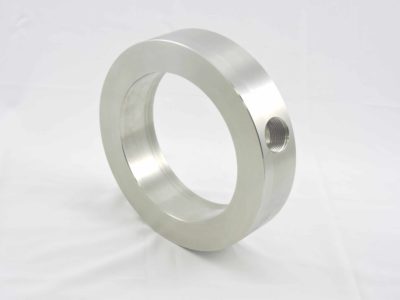
A bleed ring is a machined metal ring with one or more radial pipe connections, designed to fit between standard flanges within the bolt circle using conventional gasket material. The ring typically comes with a ¾” NPT threaded tap or ½” socket weld connection for attaching valves and instruments.
Bleed rings provide a convenient way to drain piping, take process samples, attach instruments, or relieve pressure ahead of valve maintenance — a critical step when replacing leaky valves in systems carrying hazardous or high-pressure fluids.
Unified Alloys stocks bleed rings in stainless steel and other corrosion-resistant materials. Custom configurations including multiple taps, larger tap sizes, and alternative materials are available on request.
1" NPS tappings and above require a thicker bleed ring to accommodate the additional outside diameter of the tapping. Ensure your stud bolts are long enough to accommodate the ring thickness between flanges.
Key Applications
- Process sampling and pressure monitoring
- Instrument and gauge connections
- Pressure relief and system depressurization
- Draining piping during maintenance
- Chemical processing and oil & gas systems
Materials & Grades
Available Materials
Unified Alloys supplies bleed rings in a range of materials to suit different process environments. All bleed rings conform to ASME B16.5 for dimensional standards and ASME B16.20 for gasket surface requirements.
The most common choice for corrosion resistance in chemical processing, oil and gas, and food-grade applications.
304 · 304L · 316 · 316L · 317L · 321 · 347
Suitable for general-purpose and low-temperature service where corrosion resistance is not the primary concern.
A105 · A350 LF2 · A516 Gr.70
Available on request for severe service or high-temperature conditions requiring exceptional performance.
Duplex 2205 · 6Mo · Monel · Inconel
Tap Sizes & Ring Thickness
Standard Tap Configurations
Standard bleed rings are manufactured with one ½” or ¾” NPT threaded tap, or socket weld connection. Multiple taps can be provided but must be oriented by the customer at time of order.
1″ NPT tappings and above require a thicker bleed ring to accommodate the additional outside diameter of the connection. Standard ring thickness by tap size:
| Tap NPS | Ring Thickness |
|---|---|
| ½” | 1-½” |
| ¾” | 1-½” |
| 1″ | 2″ |
When specifying bleed rings, ensure your stud bolts are long enough to accommodate the ring thickness between flanges.
Technical Data
Dimensional Data
For complete dimensional data including outside diameter and bore dimensions by pressure class, see our full ASME B16.5 reference chart.
Bleed Ring Dimensions — ASME B16.5 | Class 150 Through 2500
Full dimensional data by pressure class · Downloadable PDF version available
Regulatory
CRN & Regulatory Considerations
Depending on your jurisdiction and intended use, bleed rings may need to be registered as a fitting and require a Canadian Registration Number (CRN). Despite being comparable to very thick, solid metal gaskets, bleed rings can fall under pressure equipment regulations in provinces including Alberta, British Columbia, Saskatchewan, and Ontario.
If you’re unsure whether your application requires CRN registration, our technical sales team can advise based on your specific use case and jurisdiction.
FAQ
Frequently Asked Questions
What is a bleed ring used for?
Bleed rings are used to drain piping, take process samples, attach instruments (pressure gauges, thermocouples), or relieve trapped pressure before breaking a flange connection. They are commonly used in oil and gas, chemical processing, and industrial piping systems.
What is the difference between a bleed ring and a drip ring?
They are the same product. Bleed rings are also commonly referred to as drip rings, vent rings, bleeder rings, or test inserts. The terminology varies by region and industry but the component and its dimensional standards are identical.
What sizes are bleed rings available in?
Standard bleed rings are available in NPS 1 through NPS 24, in ASME pressure classes 150 through 2500. Not all size and class combinations are available — for example, Class 2500 bleed rings are only manufactured up to NPS 12.
What materials are bleed rings available in?
Unified Alloys offers bleed rings in stainless steel grades including 304, 304L, 316, 316L, 317L, 321, and 347. Special alloys such as Duplex 2205, 6Mo, Monel, and Inconel are available on request. Carbon steel options (A105, A350 LF2, A516 Gr.70) are also available.
Do bleed rings require a CRN in Canada?
Bleed rings may require registration as a fitting and a CRN depending on your province and intended application. This is common in Alberta, BC, and other provinces with pressure equipment regulations. Contact our team for guidance on your specific requirements.
Can I get a bleed ring with multiple taps or custom configurations?
Yes. Multiple ½” or ¾” NPT taps can be provided — tap orientation must be specified by the customer. Larger tap sizes (1″ and above), alternative face types (RTJ, flat face), and non-standard materials are also available. Note that larger or additional taps may affect the required ring thickness.
What's the difference between a bleed ring and an orifice flange?
Both fit between flanges and provide access points, but they serve different primary purposes. A bleed ring is a thin ring designed for access — draining, sampling, and instrument connections. It’s simpler to install and significantly more affordable. An orifice flange is a heavier, purpose-built assembly designed primarily for precise flow measurement. If your requirement is pressure relief, drainage, or instrument access rather than accurate flow data, a bleed ring is the more practical and cost-effective choice.
Ready to Order or Need Help Sizing?
Our technical sales team can help you select the right size, material, and configuration for your application.